



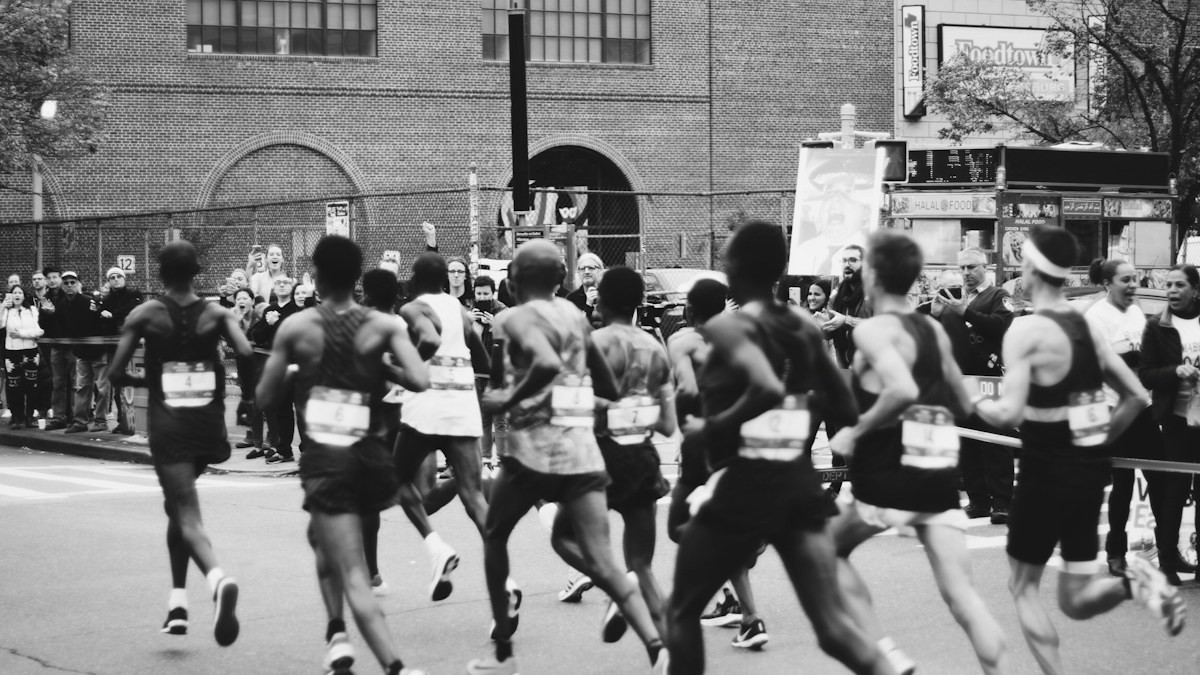
In distance running, injuries rarely stem from sheer cardiovascular exertion; they originate from repetitive mechanical shock. Every mile you run subjects your lower limbs to roughly 1,500 foot strikes, each generating an impact transient equal to two to three times your entire body weight. When runners possess a slow, plodding stride, they inadvertently cast their foot far ahead of their center of mass—a biomechanical flaw known as overstriding.
Running cadence biomechanics—the rate at which your feet strike the ground per minute (SPM)—governs how impact forces propagate through your ankles, shins, and knees. Renowned Olympic coach Jack Daniels first identified that elite distance runners naturally gravitate toward a cadence of approximately 180 steps per minute, regardless of their height or running velocity.
This comprehensive biomechanical analysis explains why shifting toward a cadence of 175 to 185 steps per minute provides immediate joint preservation and running economy benefits. You will learn how to measure your baseline cadence, eliminate destructive braking forces, execute targeted metronome retraining drills, and protect your knees for decades of pain-free endurance running.
The Physics of Overstriding and Ground Reaction Braking Forces
Understanding the destructive mechanical consequences of landing with your foot ahead of your pelvis.
The Braking Transient: Turning Forward Momentum into Joint Shock
When an athlete overstrides at a low cadence (typically between 150 and 165 steps per minute), the foot makes initial ground contact well ahead of the body’s center of mass with an extended, locked knee joint. At this moment, the foot acts as a physical brake against forward momentum.
Rather than absorbing impact through elastic muscular flexion, kinetic energy radiates straight upward through the calcaneus heel bone, into the tibia, and across the patellofemoral joint. High-speed force plate analysis proves that overstriding produces an abrupt, high-amplitude impact transient spike responsible for runner’s knee, shin splints, and femoral stress fractures.
Vertical Oscillation and Wasted Gravitational Energy
Low cadence running is characterized by excessive vertical oscillation—bouncing up and down excessively with each step. Bouncing higher does not propel you forward; it forces your legs to absorb greater gravitational landing shocks.
Increasing your cadence to 180 steps per minute flattens your flight trajectory, reducing vertical oscillation from 10-12 centimeters down to 6-8 centimeters. This conservation of kinetic energy drastically lowers oxygen consumption, boosting overall running economy by up to 6%.
Anatomical Load Redistribution: Knees vs Calves and Achilles
How cadence shifts mechanical stress away from vulnerable joints and into spring-like tendons.
Unloading the Patellofemoral Joint
Orthopedic studies at the University of Wisconsin demonstrated that increasing cadence by just 10% reduces peak patellofemoral joint contact force by 21% and decreases peak hamstring elongation during the late swing phase by 14%.
By landing with a slightly flexed knee directly beneath the pelvis, the quadriceps and patellar tendon no longer endure severe eccentric braking loads. For runners struggling with chronic anterior knee pain or chondromalacia patellae, cadence retraining is more therapeutically effective than custom orthotics or knee braces.
The Adaptation Demand on the Achilles and Plantar Complex
While a higher cadence spares the knees, it shifts mechanical work downward into the gastrocnemius, soleus, and Achilles tendon complex. A shorter, quicker foot strike demands elastic energy recoil from the plantar fascia and calf muscles.
Runners who attempt an instantaneous jump from 155 SPM directly to 185 SPM without adequate soft tissue conditioning frequently develop acute Achilles tendonitis or calf tightness. A progressive, phased transition is essential to allow collagen remodeling in the lower leg.

The Step-by-Step Cadence Retraining Protocol
A structured 6-week progression using acoustic metronomes and cadence playlist cues.
Establishing Your Baseline Cadence Under Neutral Conditions
Before initiating retraining, calculate your true baseline cadence. Wear your standard running watch during a flat, easy 5-mile run at your normal conversation pace. Do not attempt to run faster or alter your stride.
Review your average cadence in Garmin Connect or Strava. Most recreational runners discover their natural easy pace cadence falls between 155 and 165 SPM. Your target for the first two weeks will be an incremental 5% increase over this baseline value.
Executing Acoustic Metronome Cues on Short Intervals
Download a free metronome smartphone app or utilize a dedicated sports watch metronome feature. Set the tempo to your target cadence (e.g., 170 SPM for a runner whose baseline was 162 SPM).
Begin each easy run with a 10-minute warm-up, then engage the metronome for 3-minute blocks: focus purely on synchronizing each foot strike with the audible click. Alternate 3 minutes with the metronome and 2 minutes of silent running to lock in the neuromuscular motor pattern. Repeat for 4 to 6 cycles.
Neuromuscular Drills to Accelerate Leg Turnover
Specific running form drills designed to shorten ground contact time and promote midfoot landing.
Quick-Feet Strides and Butt Kicks with Ankle Dorsiflexion
Incorporate post-run strides twice weekly. Accelerate over 80 meters to approximately 90% of your maximum sprint speed, focusing entirely on rapid leg turnover rather than over-reaching for stride length. Stride repetitions program the central nervous system to fire motor units with rapid reactivity.
Follow strides with stationary quick-feet drills and A-skips. Emphasize active ankle dorsiflexion: pulling the toes upward toward the shin during the swing phase ensures the foot strikes the ground with a stiff, spring-loaded midfoot configuration.
Running Against a Gentle Uphill Gradient
Uphill running is nature’s most effective form coach. When running up a moderate 4% to 6% incline, it is physically impossible to overstride on your heel without halting your momentum entirely.
Incorporating weekly hill repetitions forces runners to land beneath their center of mass, automatically elevates cadence to 178-182 SPM, and strengthens the gluteal muscles and posterior chain without pounding knee joints.
Cadence Across Different Race Distances and Body Heights
Adjusting expectations based on height, terrain, and pacing demands.
The Impact of Athlete Height on Optimal Cadence
While 180 SPM is an excellent general reference target, optimal cadence is naturally influenced by leg length. Taller athletes (over 6’2″ / 188cm) with longer levers naturally operate efficiently between 172 and 178 SPM, while shorter runners frequently thrive between 180 and 188 SPM.
Do not become dogmatic about hitting exactly 180 on every single stride. Focus on the underlying biomechanical objective: landing with a soft, flexed knee directly underneath your hips with minimal ground contact time.
Dynamic Cadence Adjustments Across Race Paces
Cadence naturally varies with pace. While an elite marathoner might hold 182 SPM at a 5:00/mile marathon pace, their cadence during a slow 8:00/mile recovery jog may settle around 174 SPM. This variation is healthy and expected.
However, recreational runners who drop from 175 SPM down to 150 SPM during recovery runs recreate the very overstriding forces that cause injury. Strive to maintain at least 170+ SPM even on your easiest recovery days by simply shortening your stride length.
Running Cadence Biomechanical Comparison & Impact Metrics
| Cadence Tier | Ground Contact Time | Vertical Oscillation | Knee Impact Peak | Typical Stride Mechanics |
|---|---|---|---|---|
| Low (< 160 SPM) | > 280 ms | > 11.5 cm | High (100% baseline) | Severe overstride, heel strike braking |
| Moderate (160 – 172 SPM) | 240 – 270 ms | 9.0 – 11.0 cm | Moderate (88% baseline) | Slight overstride, extended knee |
| Optimal (175 – 185 SPM) | 200 – 230 ms | 6.5 – 8.5 cm | Low (79% baseline) | Under pelvis, midfoot spring recoil |
| Elite Sprint (> 190 SPM) | < 180 ms | < 6.0 cm | Very Low joint shock | High turnover, maximal elastic return |
Recommended Further Reading & Authoritative References
To deepen your practical mastery of these concepts, explore our comprehensive analyses on running shoes pronation and drop guide and preventing shin splints with form corrections. For official technical standards, peer-reviewed benchmarks, and industry guidelines, consult the Running Economy on Wikipedia.
Frequently Asked Questions
Why is 180 steps per minute considered the ideal running cadence?
Legendary coach Jack Daniels observed at the 1984 Olympics that elite distance runners naturally ran at or above 180 SPM, maximizing elastic tendon recoil and minimizing joint impact shock.
Will increasing my cadence automatically make me run faster?
Not immediately. When retraining cadence, you will shorten your stride so your pace remains constant while your legs turn over quicker, reducing joint stress before building speed.
How long does it take to retrain your running cadence?
Neuromuscular adaptation typically takes 4 to 6 weeks of dedicated metronome and drill work before a 175-180 SPM turnover feels completely natural and effortless.
Do tall runners need to run at 180 steps per minute?
Taller runners with longer limbs often operate efficiently between 172 and 178 SPM; the critical goal is avoiding overstriding, regardless of exact step count.