



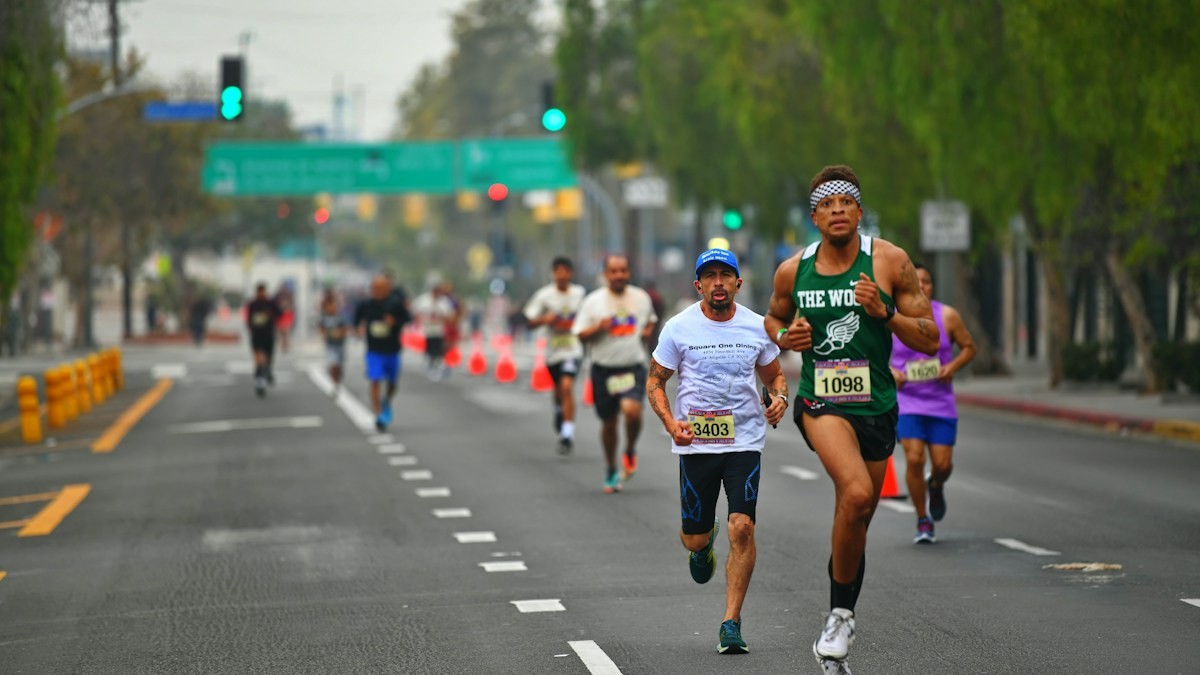
Every year, millions of individuals make a New Year’s resolution to start running, lose weight, or complete their first local 5K community race. Armed with enthusiasm and brand-new athletic gear, most give up within two weeks. The reason is not lack of willpower; it is the universal mistake of treating running like a test of suffering rather than a progressive skill to be learned.
Going from the couch to a 5K finish line requires respecting the biological timeline of human adaptation. Your heart and lungs develop cardiovascular fitness within days, but your bones, plantar fascia, and Achilles tendons remodel slowly over two months. Running continuously before your skeletal frame is ready triggers agonizing shin splints, plantar fasciitis, and knee pain.
This structured 8-week gradual run-walk progression is engineered specifically to eliminate joint injury while guaranteeing cardiovascular stamina. By systematically adjusting the ratio of running seconds to walking seconds each week, you will comfortably build up to 30 continuous minutes of running and cross your first 5K finish line with confidence, health, and athletic momentum.
The Science of the Run-Walk Aerobic Bridge
A gradual run-walk schedule bridges the gap between sedentary walking and continuous distance running safely.
Stimulating Bone Remodeling Without Microfractures
With every running stride, your lower legs absorb impact forces equal to 2.5 to 3 times your body weight. Bone tissue responds to this impact stress through piezoelectric remodeling, laying down denser calcium hydroxyapatite crystals.
However, bone remodeling takes 4 to 6 weeks. Short 60-to-90-second running intervals provide the mechanical stimulus needed for bone density growth while the walking intervals prevent microscopic stress fractures from developing.
Managing the Lactic Acid Threshold for Beginners
Beginners produce lactic acid rapidly because their mitochondrial density is low. Sprinting out of the gate causes hydrogen ions to accumulate, resulting in burning muscles and rapid fatigue.
The walking recovery interval allows your cardiovascular system to flush lactate and resynthesize cellular ATP, keeping you in an enjoyable aerobic state throughout your 25-minute workout.
Week-by-Week Tactical Progression Blueprint
Commit to three 30-minute training windows each week with a dedicated rest day between every run.
Weeks 1 & 2: The Neuromuscular Adaptation Phase
Warm up with a brisk 5-minute walk. Alternate 60 seconds of gentle jogging with 90 seconds of walking for 20 minutes, followed by a 5-minute cool-down walk.
Keep your strides short and quiet. If your feet slap loudly against the pavement, you are overstriding. Focus on soft, quiet footfalls directly beneath your torso.
Weeks 3 & 4: Expanding the Running Windows
Progress to 90 seconds of running paired with 90 seconds of walking, building to a 3-minute continuous run by the end of Week 4.
Maintain a strict conversational pace. If you find yourself breathing through wide-open gasping jaws, slow down immediately. Speed does not matter in Couch to 5K; time on feet is the only metric that builds endurance.
Weeks 5 & 6: The 20-Minute Psychological Breakthrough
In Week 5, you will run 5 minutes, walk 3 minutes, run 5 minutes. The crowning achievement of Week 5 is a single continuous 20-minute run.
Trust your training: by Week 5, your body has developed sufficient capillary networks and cardiovascular efficiency to sustain 20 minutes without stopping.
Weeks 7 & 8: Continuous 5K Readiness
Week 7 consists of 25 continuous minutes of running. In Week 8, you will run 28 minutes, 30 minutes, culminating in your official 3.1-mile (5K) event.
You have officially transformed from a sedentary couch potato into an endurance runner.
Race Day Morning Strategy: Navigating Your First 5K
Execute your first race day like an experienced veteran by avoiding classic rookie mistakes.
The Starting Corral Discipline
At the starting line of a local 5K, excited crowds and blaring music create massive adrenaline spikes. When the horn sounds, hundreds of runners sprint forward like a 100-meter dash.
Resist the urge to surge! Position yourself in the middle or back third of the corral. Run your first mile 30 to 45 seconds slower than your target average. By Mile 2, you will smoothly pass dozens of exhausted runners who sprinted too early.
Crossing the Finish Line with Pride
As you approach the finishing chute, lift your head, drive your arms, and run tall across the timing mat. Collect your medal, drink cold water, and take pride in completing one of the most transformative fitness journeys of your life.
Couch to 5K Detailed Interval & Distance Progression
| Training Phase | Weekly Mileage Target | Interval Structure | Rest Days / Cross-Train | Physical Milepost |
|---|---|---|---|---|
| Weeks 1 – 2: Foundation | 3.0 – 4.5 Miles | 60s Run / 90s Walk (8 reps) | 4 Days Rest / Active Walk | Zero shin pain; relaxed rhythm |
| Weeks 3 – 4: Aerobic Bridge | 5.0 – 6.5 Miles | 90s Run / 60s Walk + 3m Run | 3 Days Rest / Yoga / Cycle | Breathing stabilizes; posture tall |
| Weeks 5 – 6: Stamina Expansion | 7.0 – 9.0 Miles | 5m Run / 2m Walk (3 reps) | 3 Days Rest / Low-Impact Swim | Completing 20 mins total run time |
| Week 7: Continuous Mileage | 8.0 – 9.5 Miles | 20 – 25 Mins Continuous Run | 3 Days Rest / Foam Rolling | Crossing the 2.5-mile non-stop barrier |
| Week 8: 5K Race Culmination | 6.0 Miles (incl. Race) | 3.1-Mile (5K) Road Race | Full Pre-Race Rest & Taper | Official 5K Finish Line Medal |
Recommended Further Reading & Authoritative References
To deepen your understanding of these systems, review our companion analysis on 8-Week Couch to 5K Training Plan and Preventing and Treating Shin Splints. For official technical specifications and industry standards, consult the Road Runners Club of America Beginner Training Guidelines.
Biomechanical Longevity & Training Progression Safeguards
To maximize your long-term success with From Couch to 5K Finish Line, runners must respect physiological adaptation cycles and avoid premature volume escalation. Neuromuscular adaptations occur within two to three weeks, but connective tissues, ligaments, and bone mineral density adapt substantially slower over six to eight weeks of consistent stress.
Integrate dedicated mobility sequences focusing on the posterior kinetic chain, ankle dorsiflexion, and hip stabilization before each demanding training effort. Monitoring subjective recovery indicators such as resting heart rate, morning sleep quality, and muscle tightness provides early warning signs of overtraining syndrome.
Always pair focused physical training with proper sleep architecture and nutrient timing. Giving your body sufficient structural repair intervals ensures steady athletic progression while keeping chronic overuse injuries permanently at bay.
Frequently Asked Questions
What should I do if my knees ache after Week 2?
Take 2 to 3 days of rest and evaluate your running form. Knee pain in beginners is usually caused by ‘overstriding’ (landing heel-first far in front of your knee). Shorten your stride, increase your step frequency (cadence), and avoid running on concrete sidewalks when asphalt or dirt paths are available.
Can I do Couch to 5K on an outdoor track?
Yes! A standard running track is 400 meters long, meaning 12.5 laps equal a 5K. Track surfaces are rubberized and cushioned, providing an exceptionally forgiving surface for beginner joints.
Is it normal to feel completely exhausted after the first week?
Yes, mild muscular fatigue is normal as your neuromuscular system awakens. Ensure you are getting at least 7 to 8 hours of sleep and eating a balanced whole-food diet with adequate complex carbohydrates.
What comes next after completing a 5K?
After completing your 5K, spend 4 weeks solidifying your base by running three comfortable 5K runs per week before considering progressing toward a 10K or half-marathon training schedule.